Bactericidal and preservative agent BIT20
Bactericidal and preservative agent BIT20
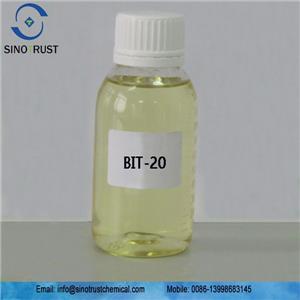
Item Name: BIT20 preservatives
Chemical Name: 1,2-Benzisothiazolin-3-one
Cas No.: 2634-33-5
EINECS No.: 220-120-9
General: The BIT20 is not a single chemical substance's standard name, but rather more likely an industrial product code or commodity identifier based on specific active ingredients. Its core function is aimed at biocide and preservation. "BIT", it usually refers to "1,2-benzisothiazolin-3-one".
The suffix "20" may be related to the effective component content, concentration indication, or specific formulation version of the product. In industrial practice, in order to ensure the stability, compatibility, and long-term effectiveness of preservatives in complex systems, the pure active ingredients are often formulated into solutions or compound preparations of a certain concentration. "BIT20" may imply that this product uses BIT as the main active ingredient and is formulated through a specific process to achieve a stable form suitable for a certain application scenario
The BIT 20 preservative agent is a heterocyclic organic compound, and its molecular structure characteristics determine its antibacterial mechanism. The active part of this molecule can penetrate the cell membranes of microorganisms and form irreversible binding with the enzyme proteins (especially those containing sulfhydryl groups) inside the cells, thereby blocking the energy metabolism and synthesis pathways of the cells, and ultimately causing the death of the microorganisms. This mechanism of action is effective against a variety of bacteria, fungi, and yeasts.
Many aqueous systems or materials rich in organic components, such as paints, adhesives, metalworking fluids, personal care product matrices, etc., provide the nutrients and moisture necessary for the growth of bacteria and fungi. Once microorganisms colonize in these systems, a series of chain reactions will occur: polymer degradation, viscosity changes, odor generation, color change, and even accelerated corrosion. The role of BIT 20 preservatives is to form a chemical barrier at this interface, interfering with the key physiological processes of microorganisms and preventing their proliferation.